VariationalAnalysis
Protocol and application: how Variational and Omni relate
Where the Variational protocol ends and the Omni application begins: what settlement pools define, what Omni decides, what OLP is, where revenue comes from and how this split affects risk.

Key points
- The protocol defines the mechanisms: isolated settlement pools, margin and liquidation rules as pool parameters, a shared oracle and RFQ with trade terms included in the quote.
- Omni fixes these parameters identically for everyone and allows a single maker — OLP — so a quote on Omni consists of the price alone.
- OLP is a USDC vault, a market making engine and a risk management system; the team provided the seed capital; as of October 2026, a community vault for outside deposits has not opened.
- As of October 2026, according to the documentation, the protocol receives 20% of the spreads paid to OLP; the share is being tested and may change.
Contents · 6 sections
Where is the line between the Variational protocol and the Omni application? In short, the protocol defines the mechanisms — settlement pools, margin and liquidation rules as configurable pool parameters, a shared oracle and the request-for-quote procedure. Omni is an application that picks one specific configuration of these mechanisms: identical parameters for all users and a single market maker, OLP.
This has a practical implication. Many of the features a user sees in Omni — one counterparty, platform-wide margin rules, a quote in the form of a single price — are choices made by the application, not limits of the protocol. To assess risk, it helps to understand at which level each decision is made.
For a general overview of the ecosystem, see “What is Variational: the protocol, its applications and how the ecosystem fits together.” This article covers only the division of roles.
What belongs to the protocol
The protocol level defines how money and positions are held and by what rules they can be liquidated. The central concept here is the settlement pool.
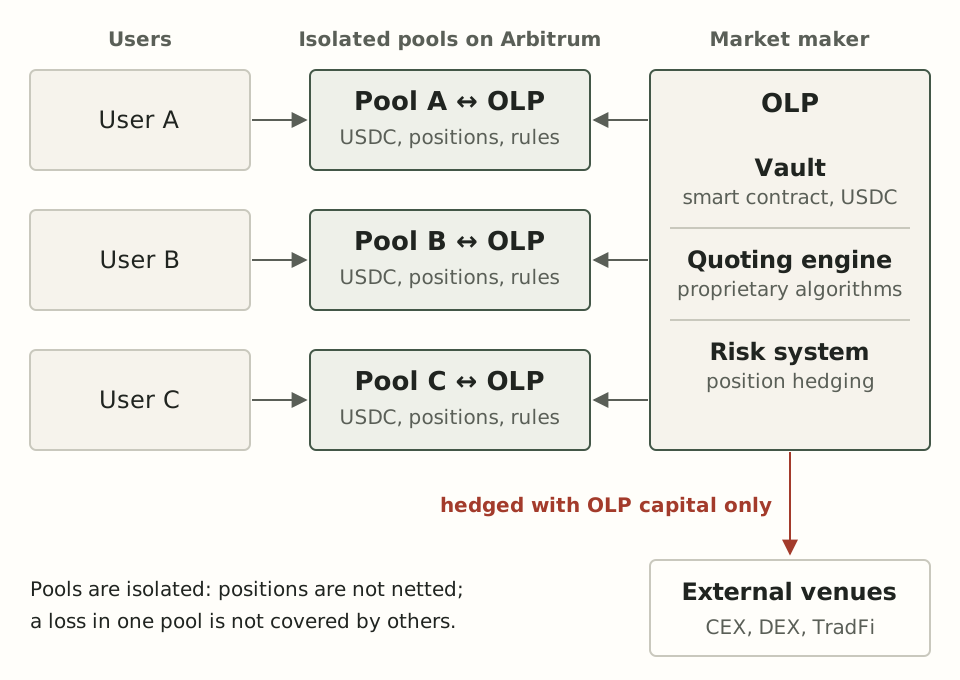
According to the documentation, a pool is a “one-to-many relationship” between the pool creator and its counterparties. A pool holds open positions, the counterparties' collateral in USDC and the rules that define margin requirements and how liquidation works. Pools are fully isolated: positions in one pool cannot be moved to another or netted against positions in another pool, and outside participants have no access to other people's funds.
The protocol allows different configurations. The documentation gives two examples: a bilateral pool between two participants and a multilateral pool between a bank and its clients, in which the clients' funds are commingled. Margin and liquidation rules can vary from pool to pool. Even the liquidation penalty and whether automatic liquidation is enabled are, according to the liquidation page, pool parameters.
The protocol's general request for quote (RFQ) reflects this flexibility. According to the description of the procedure, a maker's quote contains not only a price but also pool terms: an existing or new pool, margin requirements and liquidation penalties. The taker can send the request to all makers or only to selected ones.
What Omni decides
Omni uses the protocol's mechanisms but fixes nearly all of their parameters in advance. The difference is easiest to see side by side.
| Aspect | Protocol in general | Omni as of October 2026 |
|---|---|---|
| Makers | Any admitted maker | OLP only |
| Quote | Price and pool terms | Price only |
| Pool | Bilateral or multilateral | One “user–OLP” pool each |
| Margin and liquidation | Set per pool | Uniform across the platform |
| Auto-liquidation | Pool parameter | Enabled in all pools |
The documentation describes RFQ on Omni as a simplified version of the protocol's. The user fills in an order form, OLP responds with a price and the user accepts it. Two checks follow: OLP checks the trade against its risk limits (this is its right of final confirmation, or last look), and the final price is compared with the user's slippage limit. Only then is OLP's collateral moved from its vault into the user's pool and the trade booked.
This means an Omni user does not choose a counterparty or negotiate terms: they either accept the price or they don't. In the protocol in general, pool terms are part of what a quote offers.
OLP: the market maker inside the application
OLP (Omni Liquidity Provider) is Omni's market maker and the counterparty to every trade in the application. From the protocol's point of view, OLP is a participant in settlement pools just like a user: according to the documentation, it uses the protocol's pools and peer-to-peer clearing “just like any user.”
According to the documentation, the Variational team provided OLP's seed capital. The project intends to open the vault to user deposits later, through a community vault, once the system, in the documentation's words, has proven its stability. As of October 2026, no such vault has opened.
OLP is subject to the same rules as a user: it keeps margin in each pool and can be liquidated if its collateral falls below requirements. OLP hedges the directional position it accumulates in trades with users on external venues. According to the project, OLP never transfers user funds there — only its own capital. The sources contain no independent confirmation of this claim. The accounting design is consistent with it — user funds sit in a separate pool, not in the OLP vault — but what OLP does with its own capital on external venues cannot be verified from public data.
Where Omni's revenue comes from
According to the documentation, Omni charges no trading fees; revenue comes from the spread — the difference between the price at which OLP is willing to buy and the price at which it is willing to sell. The documentation describes the chain as follows: OLP sets the spread for each asset, users trade at its quotes and OLP hedges the accumulated risk on external venues.
The protocol receives part of this revenue. As of October 2026, according to the OLP page, 20% of the spreads users pay to OLP goes to the protocol treasury. The documentation notes that this share is still being tested and may change.
A hypothetical example of the mechanism: if the spread paid in trades over some period totaled 100 USDC, then at the current share 20 USDC would go to the protocol treasury and 80 USDC would remain with OLP. The figures are hypothetical and unrelated to actual volumes.
This shows that no fee does not mean no cost: the charge for a trade is built into the price. Other costs that exist even with zero fees are covered in “Zero trading fees: the costs that remain.”
What this split means for risk
The split into protocol and application distributes risk differently at different levels: pool isolation is a property of the protocol, while concentration on a single counterparty follows from Omni's choice.
Isolation. According to the documentation, the bankruptcy of one pool does not affect the others: losses are not spread across all users, as can happen on an exchange with a shared vault.
Explicit counterparty. The flip side of isolation is that the money in the pool is the only collateral securing trades. If a counterparty's balance goes negative, the winning side cannot collect the shortfall, and bad debt arises. On Omni, the counterparty in every pool is the same — OLP. This is our interpretation, but it follows directly from the design: isolation protects users from one another but not from problems at their common counterparty. The documentation confirms this: if OLP becomes insolvent, users' profit from that point on becomes bad debt.
OLP liquidation as an analog of ADL. If OLP is liquidated, this is, according to the documentation, the functional equivalent of automatic deleveraging (ADL) on other venues. The user's position is closed at the settlement price, and the liquidation penalty paid by OLP goes to the user. This can happen during extreme volatility or a serious liquidity shortfall at OLP.
Bottom line: one configuration among many possible ones
Omni is one possible configuration of the Variational protocol: one market maker, uniform parameters and a simplified RFQ. The protocol is responsible for where the money sits and by what rules it can be moved; the application is responsible for whom the user trades with and on what terms.
Much of this configuration depends on decisions not yet made: what the protocol's share of the spread will be after testing, who will become OLP depositors if the vault opens and how the same architecture will behave with several market makers, as planned for Pro, which as of October 2026 has not launched.
Sources
Spotted an error? Tell the editors — we will check it and publish a correction.
How we handle correctionsGet new articles by email
New articles and corrections, no more than once a week. No ads for trading services, no promo codes and no offers to open an account.