Basics and risksExplainer
Margin and liquidation: the risks behind the terms
What initial and maintenance margin are, how leverage relates to the liquidation threshold and why, in a peer-to-peer model, one side's loss can become bad debt for the other.

Key points
- Initial margin is needed to open a position and maintenance margin to keep it open; leverage is the inverse of the initial margin percentage.
- The higher the leverage, the smaller the adverse price move needed to bring collateral down to the liquidation threshold.
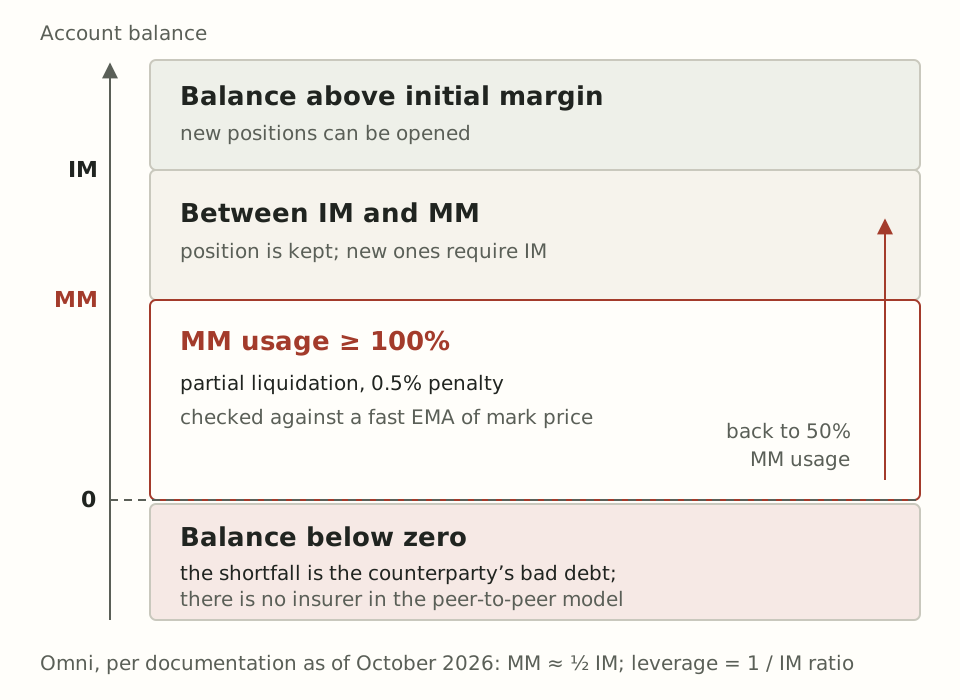
- In Omni, according to the documentation as of October 2026, liquidation is partial, triggers at 100% or more maintenance margin usage and carries a 0.5% penalty.
- A peer-to-peer model has no outside insurer: if one side's balance goes negative, the shortfall becomes bad debt for its counterparty.
Contents · 10 sections
Margin is the collateral requirement a participant must maintain behind an open position, and liquidation is the forced closing of a position when collateral falls below the required minimum. Both terms describe the same thing: the rules by which a system protects counterparties from the losses of a party that cannot cover them.
Behind the terms are concrete risks: a position can be closed without its owner's involvement, at a price worse than the market and at an inconvenient moment, and in a sharp market move the collateral may not be enough at all. Below is how this works in general and in the parameters described in the documentation of the Omni application built on the Variational protocol. As of October 2026, according to the documentation, Omni's mainnet is in private beta, and the parameters may change.
Collateral and margin: what is the difference
Collateral is the funds in the account; margin is the requirement for how much of them there must be. In Omni, the collateral is USDC held in a settlement pool: according to the documentation, each user has their own bilateral pool with the liquidity provider OLP.
According to the margin documentation, margin requirements are set for each pool separately, but in Omni all pools follow the same platform-wide rules. Margin is recalculated in real time, which means the collateral level changes along with the price.
The first consequence follows: there is less free balance in the account than it may seem. According to the description of settlement pools, only the unused balance can be withdrawn from a pool — down to the maintenance margin level.
Initial and maintenance margin
Initial margin (IM) is the minimum collateral needed to open a position; maintenance margin (MM) is the minimum needed to keep it open. Maintenance margin is lower than initial margin, and the gap between them acts as a buffer against price swings.
In Omni, according to the documentation, maintenance margin is generally half of initial margin. Both are expressed as a percentage of the position's notional value.
How leverage relates to liquidation risk
The higher the leverage, the smaller the adverse price move needed to bring collateral down to the liquidation threshold. This is a mechanical property: for the same notional value, higher leverage means a narrower buffer between initial and maintenance margin in absolute money terms.
The Omni documentation also notes a less obvious effect. If the selected leverage is reduced for the same position and the same collateral, both initial and maintenance margin requirements rise, and the estimated liquidation price may move closer. Here “leverage” is a setting that determines the margin percentage, not the actual ratio of the position to the funds in the account. The two meanings of the word are easy to confuse.
Cross margin and isolated margin
The margin mode determines which funds back a position and which positions a liquidation can affect. In Omni, according to the documentation, both modes are available on some markets.
| Mode | What backs the position | What liquidation affects |
|---|---|---|
| Cross margin | The shared USDC balance | Any position in this mode |
| Isolated | Funds allocated to one position | Only that position |
In cross margin mode, the shared balance serves as collateral for all positions in that mode, so their risks are pooled: a loss on one position can lead to the liquidation of another. In isolated mode, according to the documentation, liquidation affects only one position, and the others are separated from it. The flip side is that requirements are calculated only against the allocated funds, so such a position can reach the threshold even while the main account has a free balance. According to the documentation, isolated margin will remain the only mode for Omni swaps until round-the-clock trading becomes available for them.
When liquidation is triggered
Liquidation in Omni begins when maintenance margin usage reaches or exceeds 100%. In other words, the balance has become equal to or fallen below the maintenance margin requirement.
An important detail is which price this is checked against. According to the liquidation documentation, positions are marked to market using a very fast exponential moving average (EMA) of the mark price. The mark price, in turn, is calculated from the index price and additional data, including funding and OLP's risk profile.
This means a brief price spike affects the calculation less than a sustained move. It is reasonable to assume that smoothing does not protect against a fast but prolonged move; the documentation does not disclose the exact EMA parameters.
Partial liquidation and the penalty
Omni closes part of a position rather than all of it. According to the documentation, if maintenance margin usage is 100% at the moment of liquidation, the partial liquidation is sized to bring the account back to 50%. The logic is to restore the buffer without closing the whole position.
The closing comes with a penalty. As of October 2026, according to the documentation, it is 0.5%: a long position is closed at the bid price minus 0.5%, and a short at the ask price plus 0.5%. The party whose balance triggered the liquidation is treated as the taker and pays the penalty; the other party is the maker.
As a result, a forced close costs more than an ordinary one: the penalty is added to the quoted price. This is one of the costs that does not appear in the “trading fee” line.
Gaps, bad debt and the peer-to-peer model
Liquidation protects the counterparty only if the market allows time to carry it out. If the price jumps past the threshold (a gap), a party's balance can go negative before the position can be closed.
The Variational documentation calls this situation bad debt. In the protocol's peer-to-peer model, every position has a specific counterparty, and trades are backed only by the funds in the pool. A bankrupt party cannot be forced to pay in the shortfall, and there is no outside insurer, so the winning side does not receive part of its profit.
The documentation contrasts this with the exchange model, where user funds are commingled and the exchange guarantees payouts as long as it remains solvent itself. The flip side of the exchange model, as the project puts it, is the possibility of spreading losses across all users. Variational's pools are isolated, and according to the documentation, the bankruptcy of one pool does not affect the others.
Counterparty liquidation and ADL
Margin requirements in Omni apply to both sides of a trade, including OLP. If OLP itself is liquidated, the user's position is closed along with it.
The documentation describes this as the functional equivalent of automatic deleveraging (ADL) on other venues. According to the counterparty liquidation page, it is a last-resort measure that can occur during extreme volatility or severe liquidity constraints at OLP. In this case the user receives the liquidation penalty as a reward, because the party being liquidated is the one penalized.
For the user, this is a different kind of risk: the position is closed not because of their own balance but because of the counterparty's condition, and at a moment they did not choose. On the OLP page, the documentation also warns that OLP can lose money and that, if it becomes insolvent, user profits accrued from that point on will become bad debt.
A parallel with traditional markets
Similar risks have long been described for brokerage margin accounts. As defined by Investor.gov, the educational resource of the U.S. Securities and Exchange Commission (SEC), a margin account is a brokerage account in which the broker lends the investor money using the account itself as collateral. A bulletin from the SEC's Office of Investor Education dated June 10, 2021, warns that losses can exceed the amount invested, that the broker can sell the customer's securities without consulting them and that the broker may raise margin requirements at any time without advance notice.
The structural difference is significant. A margin account involves a loan, and an uncovered loss remains the customer's debt to the broker. In the peer-to-peer model described here, there is no loan, and a shortfall that cannot be recovered becomes, according to the documentation, bad debt for the counterparty. What the two share is the mechanism of forced closing without the owner's consent.
Summary: what lies behind the liquidation threshold
Margin and liquidation are not abstract settings but rules for allocating losses. They determine when a position stops depending on its owner's decisions, at what price it will be closed and who loses if collateral runs short.
The Omni documentation discloses the main parameters: the margin ratio, the trigger, the size of a partial liquidation and the penalty. But some questions remain open: the EMA parameters, how positions are selected during a counterparty liquidation and how often values marked “currently” will change. For how the protocol itself works and OLP's role, see “Protocol and application: how Variational and Omni relate”; for protocol risks in general, see “DeFi protocol risks: from smart contracts to counterparties”.
Sources
Spotted an error? Tell the editors — we will check it and publish a correction.
How we handle correctionsGet new articles by email
New articles and corrections, no more than once a week. No ads for trading services, no promo codes and no offers to open an account.