Basics and risksExplainer
DeFi protocol risks: from smart contracts to counterparties
The classes of risk that make up the overall risk of a decentralized finance protocol, where each one arises and why a code audit covers only part of the picture.

Key points
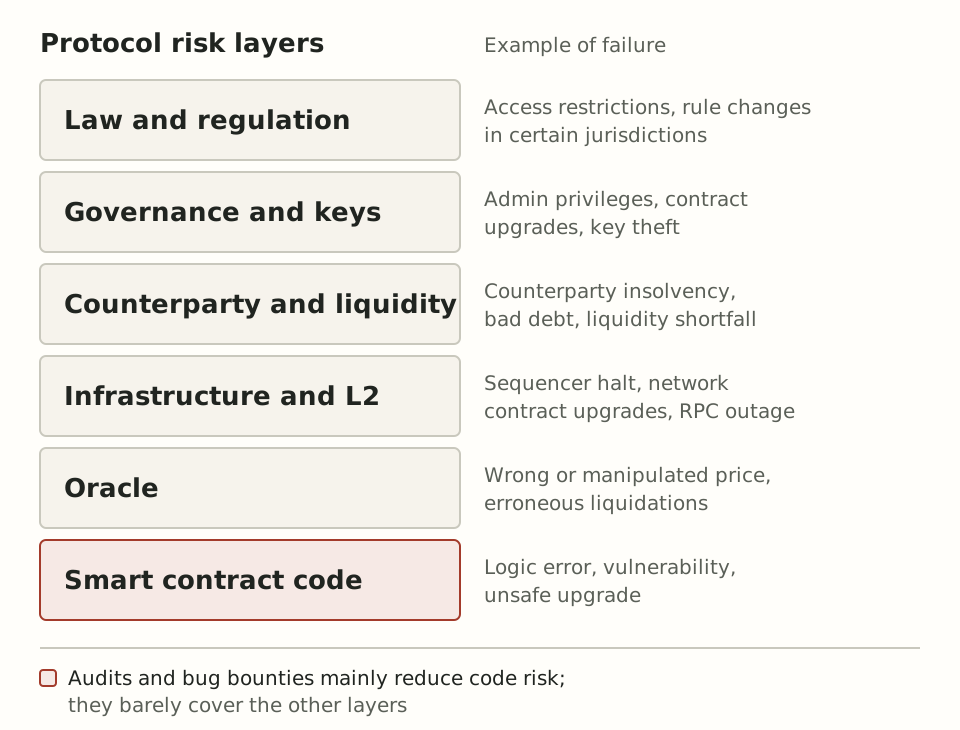
- Protocol risk has several layers: code, oracle, infrastructure and L2, counterparties and liquidity, keys and governance, law.
- An audit describes a specific version of the code on a specific date and does not guarantee the absence of bugs; a bug bounty complements an audit rather than replacing it.
- In a peer-to-peer model, according to Variational's documentation, the collateral in a pool is the only source of payouts; if a counterparty's balance goes negative, bad debt arises.
- Centralized elements such as keys, oracle operators and sequencers persist even in “decentralized” systems; the BIS calls full decentralization in DeFi an illusion.
Contents · 10 sections
What can go wrong with a decentralized finance (DeFi) protocol if its code has not been hacked? Quite a lot. A bug in a smart contract is only one class of risk. Others include a wrong price from an oracle, a network outage or upgrade, an insolvent counterparty, leaked keys, decisions made by a small group of people and changes in the law.
These classes are largely independent of one another. Flawless code does not protect against a distorted price coming in, and a reliable oracle does not protect against a counterparty running out of collateral. Below is a map of risks by layer, examples from public sources and a look at what audits and bug bounty programs (rewards for reporting vulnerabilities) guarantee and what they do not. Where it helps, we show how a given risk is described in Variational's documentation.
Why protocol risk is several different risks
A protocol is not just smart contracts; it is also the data, the network, the people and the agreements around them. Each layer can fail in its own way, and checking one layer tells you nothing about another.
Smart contract code and upgradeability
A smart contract executes exactly what is written in it, bugs included. If the logic for calculating balances, liquidations or withdrawals contains a vulnerability, funds can be lost without any “hack” in the everyday sense; it is enough to call functions in an unanticipated order.
The ethereum.org page on smart contract security cites historical examples: The DAO hack, in which 3.6 million ETH was drained, and the incidents involving Parity wallets. The same page notes that testing does not find every bug.
Upgradeability is a separate question. Many contracts are designed so that their logic can be replaced. This makes it possible to fix bugs, but it also means that someone has the right to change the code. Ethereum.org describes sole control as a single point of failure: if the owner's keys are compromised, the contract itself can be attacked. Multisignature wallets and a delay before execution (a timelock) reduce this risk but do not eliminate it.
How this looks at Variational: the terms of use state plainly that the absence of vulnerabilities in the code and smart contracts cannot be guaranteed, and they place the risk of losing funds through a failure or exploit on the user. In the documentation snapshot as of October 16, 2026, we did not find a description of whether the protocol's contracts are upgradeable or who holds admin rights. This does not mean that such rights exist or that they do not; it is a question the documentation does not yet answer.
Oracle: the price everything else depends on
An oracle delivers outside data to the blockchain, most often prices. Collateral valuation, margin and liquidations all depend on that data, so a wrong price coming in leads to wrong actions by the contract, even if the code works flawlessly.
Mango Markets is an illustrative case. According to a CFTC press release dated January 9, 2023, the regulator charged a trader with buying up the MNGO token on venues whose data the platform's oracle used. According to the CFTC, the oracle price of MNGO rose more than 13-fold in about 30 minutes, and the inflated value of the positions was used as collateral to withdraw more than $110 million. These are allegations from a civil complaint, not court findings as of the date of the release. What matters for understanding the risk is the mechanism: the contracts did what they were designed to do, and the vulnerability lay in the data source.
According to the project's documentation, Variational has its own oracle, which combines prices from several venues using weights. The weighting methodology has not been publicly disclosed. For more on how oracles work and where they fail, see “Oracles: how outside data reaches the blockchain and where it breaks.”
Infrastructure and L2
A protocol deployed on a layer 2 (L2) network inherits that network's risks. According to the Mainnet Contracts page in the project's documentation, Variational's contracts are deployed on Arbitrum.
In a rollup, transactions are accepted and ordered by a sequencer. According to L2BEAT, as of October 2026, if the Arbitrum One sequencer fails, users can force a transaction to be included via Ethereum, but with a delay of up to a day. For a protocol with liquidations, this matters: while transactions are not going through, positions can be neither topped up nor closed.
The second risk is the upgrade keys of the network itself. L2BEAT notes that all critical Arbitrum One contracts are upgradeable and that an emergency Security Council can change them without delay. A user of the protocol therefore trusts not only its developers but also those who control the network. L2BEAT classifies Arbitrum One as a “Stage 1” rollup; this is an assessment of the degree of decentralization, not a guarantee of security, and it can change. For more, see “Why crypto applications use layer 2: the Arbitrum example.”
Infrastructure also includes off-chain components. According to Variational's documentation, the connection to Arbitrum runs through the RPC providers Alchemy and QuickNode, and transactions are submitted by an off-chain component (the transactor). A failure at any of these links can delay operations even if the contracts and the network are working.
Counterparty and liquidity
Counterparty risk is the risk that the other side of a trade will be unable to pay. On a blockchain, it does not disappear but changes form: instead of an exchange's promise, payouts are backed by collateral held in a smart contract.
Variational's documentation describes the protocol as peer-to-peer: every position has an explicit counterparty, and funds are separated into isolated settlement pools. The documentation also names the price of this design. The collateral in a pool is the only source of payouts. If the market moves so fast that a counterparty's balance goes negative, there is no way to force it to deposit more funds, and bad debt arises. The guarantee that, in the exchange model, comes from the solvency of the exchange itself does not exist here. The flip side, according to the project, is the absence of contagion: the bankruptcy of one pool does not affect the others.
In the Omni application, there is a single counterparty to all trades: the project's market maker, OLP. The OLP documentation is direct about it: as with any market-making system, there is a risk that OLP will lose money, and if OLP were insolvent, users' unrealized and realized PnL accrued going forward would become bad debt. According to the project, OLP hedges positions on external venues using only its own capital and does not move traders' funds there. One can note that a loss OLP incurs on an external venue does not directly affect users' pools, but it does weaken the counterparty itself.
Liquidity risk is closely related: a market maker is constrained by its capital and risk limits. Omni's documentation, for example, lists limits that can cause a trade to be rejected. And if OLP itself reaches its liquidation level, users' positions are forcibly closed; the documentation calls this a functional equivalent of auto-deleveraging (ADL).
A real-world example of counterparty risk in a centralized model is FTX. According to Reuters, on November 11, 2022, the exchange, its affiliated trading firm Alameda Research and about 130 related companies filed for Chapter 11 bankruptcy in the United States after an outflow of client funds: about $6 billion in withdrawal requests within 72 hours.
Custody and key management
Whoever controls a private key controls the funds or the contract functions behind it. This risk exists for both the user and the protocol operator, and a code audit does not examine it.
On the user's side, Variational's terms of use make users responsible for keeping their own wallet keys safe. On the protocol's side, according to the partners page, Variational uses Fireblocks to secure contract deployments and to sign oracle data. This means that the integrity of prices depends, among other things, on how the operator stores its signing key.
Governance and centralization
Every protocol has points where people make decisions: margin and penalty parameters, listings, oracle settings, upgrades. In the December 2021 review “DeFi risks and the decentralisation illusion”, BIS researchers write that full decentralization in DeFi is an illusion: the need for governance makes some degree of centralization inevitable, and the structure of these systems concentrates power in the hands of a few. Among DeFi's vulnerabilities, they name high leverage, liquidity mismatches, the built-in interconnectedness of applications and the lack of shock absorbers of the kind banks provide in the traditional system.
Variational's documentation explicitly marks parameters as subject to change. As of October 2026, according to the documentation, the liquidation penalty on Omni is 0.5% (described as the “currently” set value), and the share of the spread that goes to the protocol treasury is 20% and “still being tested and is subject to change.” This is not a flaw in itself, but it shows that the terms are set by the operator. Among the reasons a trade may be rejected, the risk limits page also lists one in which trading on Omni has been disabled by admins. Our interpretation: the oracle, the market maker and the protocol were developed by the same team, so operational risks are concentrated with a single operator.
Legal and regulatory risk
Rules for crypto derivatives differ from country to country and change over time. This can restrict access to a service, change its terms or lead to legal proceedings.
The Restricted Persons page in Variational's documentation (updated April 20, 2026) lists the territories and categories of persons to whom the service is not provided, including the United States and Canada. The terms of use were updated on September 11, 2026, and explicitly place the risks associated with using the platform on the user. Legal documents determine who bears the loss when something fails, so they are as much a part of the risk picture as the code.
What audits and bug bounties guarantee and what they do not
An audit is a review of a specific version of the code by a specific team on a specific date. It reduces the likelihood of bugs in the reviewed contracts, but it does not prove their absence and says nothing about the oracle, keys, counterparties or law.
The ethereum.org security page stresses that audits do not find every bug and serve as an additional round of review. A bug bounty program pays researchers for responsibly disclosing vulnerabilities. Its effectiveness, according to the same page, depends on whether the payouts are commensurate with the amount of funds at risk.
Variational's audits page lists two completed audits, by Zellic (December 2024) and Spearbit (March 2025), with the reports published. The project states that it continues to commission audits as new features are released. The bug bounty program, according to the documentation, runs on the Immunefi platform. To understand what exactly is covered, you need to look at the scope and date in the reports themselves and compare them with the features that appeared later.
| Risk class | What a code audit provides | What remains |
|---|---|---|
| Code | Review of a version on a date | Later changes |
| Oracle | Logic for accepting prices | Quality of sources |
| L2 | Almost nothing | Sequencer, network keys |
| Counterparty | Margin rules in the code | Solvency |
| Keys, law | Nothing | Operational decisions |
Conclusion: the risks are connected
It is convenient to look at risk classes one at a time, but they materialize in chains. A distorted oracle price leads to erroneous liquidations. A sequencer outage prevents margin from being topped up in time. A sharp market move in a peer-to-peer model turns into a counterparty's bad debt. So the question “was there an audit?” is useful, but it is far from the whole story of a protocol's risks.
For Variational, the questions the documentation leaves open are the oracle weighting methodology, the upgradeability of the contracts and the distribution of admin rights, the size of OLP's capital and its strategy, and audit coverage of features released after March 2025. More articles on how markets work are in the Basics and risks section.
Sources
- 1.P2P Trading Protocol vs DEX
- 2.The Omni Liquidity Provider (OLP)
- 3.Audits
- 4.Partners
- 5.Risk Limits / Rate Limits
- 6.Terms of Use
- 7.Restricted Persons
- 8.Smart contract security
- 9.CFTC Charges Avraham Eisenberg with Manipulative and Deceptive Scheme to Misappropriate Over $110 million from Mango Markets (Release 8647-23)
- 10.Arbitrum One
- 11.DeFi risks and the decentralisation illusion
- 12.Crypto exchange FTX files for bankruptcy as wunderkind CEO exits
Spotted an error? Tell the editors — we will check it and publish a correction.
How we handle correctionsGet new articles by email
New articles and corrections, no more than once a week. No ads for trading services, no promo codes and no offers to open an account.