Basics and risksExplainer
Funding rate: where it comes from and why it changes
Why perpetual contracts involve regular payments between buyers and sellers, what the rate is made of and what makes it rise, fall and change sign.
Key points
- A perpetual contract has no expiration date, so its price is anchored to the index through regular payments between longs and shorts.
- A positive rate means longs pay shorts; a negative rate means shorts pay longs.
- In many implementations, the rate is the contract's premium to the index plus a small interest component; a clamp function limits how far the rate can deviate from the premium, and an overall cap applies on top.
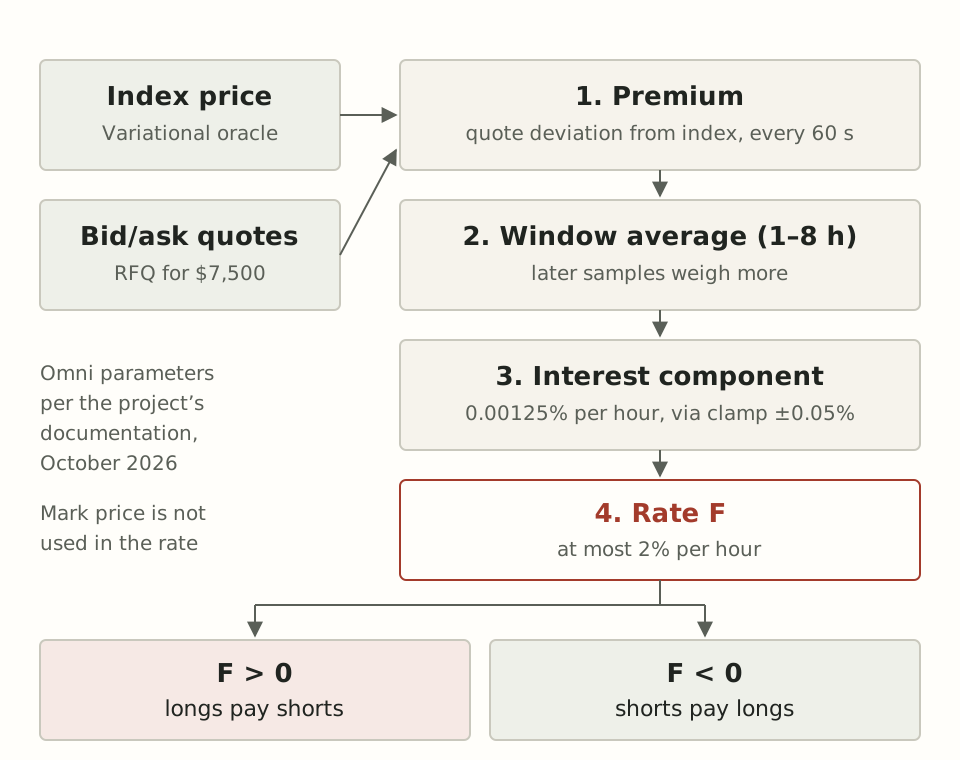
- In Omni, according to the documentation as of October 2026, the premium is calculated every 60 seconds from quotes for $7,500 and the final rate is capped at 2% per hour.
Contents · 6 sections
The funding rate is a periodic payment between holders of long and short positions in a perpetual future. It exists because such a contract has no expiration date, and without an additional mechanism its price could diverge from the price of the underlying asset indefinitely.
The sign of the rate sets the direction of the payment: when the rate is positive, buyers (longs) pay sellers (shorts); when it is negative, the reverse. The size of the rate depends on how far the contract price has moved from the index price, so it changes along with the balance of supply and demand in the market.
Below we describe the general logic of the mechanism, then walk through the specific formula described in the documentation of Omni, an application running on the Variational protocol. As of October 2026, according to the documentation, Omni's mainnet is in private beta.
Why a perpetual contract needs funding
Funding does for a perpetual contract what the expiration date does for a regular future: it creates a force that pulls the contract price toward the price of the underlying asset. A dated future's price converges with spot at expiry, because at that moment the contract settles at the asset's price. A perpetual contract has no such moment.
Without an anchor, the contract price would reflect only the balance between those who want to buy and sell the contract itself. If buyers consistently outnumbered sellers, the contract could trade well above the asset, and it would no longer serve its purpose: providing exposure to the asset's price.
Funding solves this problem economically. When the contract trades above the index, the rate is positive: holding a long position requires a payment, and the short side receives it. This is how the mechanism creates pressure to reduce the imbalance. When the contract trades below the index, everything works in reverse.
Importantly, the payment flows between market participants. In a perpetual contract, every long position has a matching short, and the rate only determines which side pays the other.
What the rate is made of
In many implementations, the funding rate has two parts: the contract's premium to the index and an interest component. The premium reflects the current imbalance in demand; the interest component reflects a notional cost of money.
The index price is the price of the underlying asset compiled from several sources. In Omni, according to the project's documentation, it is supplied by Variational's own oracle, which combines data from different venues.
The premium index shows how far the prices at which the contract can actually be bought or sold differ from the index. It is not taken from a single trade: the value is measured many times and averaged over the calculation window. Averaging reduces the impact of short-lived outliers.
The interest component is a small fixed value. It is linked to the premium through a clamp function, which “clamps” the difference between the interest rate and the premium within a narrow band. As a result, when the premium is small, the final rate equals the interest component, and when it is large, the rate is determined almost entirely by the premium.
How it works in Omni
The Omni documentation publishes the rate formula in full. The parameters below are as of October 2026, according to the Funding Rates page; the project may change them.
F = P + clamp(r − P, −0.0005, 0.0005)

F — funding rate
P — weighted average premium index over the calculation window
r — interest component: 0.00125% per hour
clamp(x, a, b) — x, bounded below by a and above by b
The premium at each point is calculated from quote prices, not from the last trade:
premium = impact_price_difference / index_price

impact_price_difference =
    max(impact_bid − index_price, 0) − max(index_price − impact_ask, 0)
Quotes at the “impact” size
The impact bid is the price at which the liquidity provider is willing to buy a given amount; the impact ask is the price at which it is willing to sell that amount. In Omni, all trades go through a request for quote (RFQ) to the liquidity provider, OLP. According to the documentation, the premium is calculated using an RFQ for a notional of, generally, $7,500, and the part of the spread that reflects hedging costs is subtracted from the quotes.
The formula implies one non-obvious detail. If the index lies between the impact bid and the impact ask, both parts of the difference are zero and the premium is zero. A premium appears only when the entire bid-ask range shifts above or below the index. A wide spread by itself does not move the rate; what moves it is a shift in prices relative to the index.
Sampling frequency and weights
The premium is measured every 60 seconds and then averaged with linearly increasing weights: sample number i out of N has a weight of 2i / (N(N+1)). The weights sum to one, and the later samples in the window carry more weight than the earlier ones.
For a one-hour window, that is 60 samples, and the last one carries 60 times the weight of the first. This means the rate responds more strongly to market conditions near the end of the window than at its start.
Rate caps
There are two limits. The first is the clamp band: because of it, the final rate cannot differ from the average premium by more than 0.05% (0.0005) in either direction. The second is an overall cap: according to the documentation, the rate cannot exceed 2% per hour, except in special circumstances that require a manual override.
Calculation window
The window length in Omni is variable, from 1 to 8 hours, and is chosen by a “waterfall” of rules. If the market exists on Bybit, the window matches Bybit's. If not, but the market exists on Binance, it matches Binance's. Otherwise, the window is one hour.
The documentation gives an example with an eight-hour window: for the first seven hours, the hourly rate is zero, and in the eighth hour the rate is calculated from the data for all eight hours.
A discrepancy in the documentation's example
The same documentation page includes a numerical example in which the interest rate is entered as 0.00001 (0.001%), whereas the text states 0.00125% per hour, or 0.0000125. The discrepancy does not affect that example's result: the premium in it is large, and clamp returns the edge of the band either way. But with a small premium, the difference between the two values would carry through to the final rate. This article uses the value from the formula text; the documentation does not clarify which of the two values applies in practice.
Relationship to the mark price
The documentation specifically stresses that the mark price is not used in calculating the rate. At the same time, the page on prices names funding as one of the inputs to the mark price. There is no contradiction here: the dependency runs one way — the rate affects the mark price, not the other way around.
Why the rate changes
The rate changes because the premium changes, and the premium reflects several processes at once. There are three main factors.
Demand imbalance. If participants open positions on one side en masse, the liquidity provider shifts its quotes, and the bid-ask range moves away from the index. In Omni, according to the documentation, OLP's quotes depend on market conditions, trade size, available liquidity and OLP's current risk profile. Presumably, a one-sided position accumulated by OLP is reflected in shifted prices and, therefore, in the premium.
Volatility. When the asset price moves sharply, the uncertainty that the liquidity provider builds into its quotes increases. One can expect quotes to move away from the index more often and more sharply during such periods, in either direction.
Liquidity at the impact size. The premium is calculated not at the best price but at the price for a meaningful amount. The thinner the market, the more the price for that amount can differ from the index, so the premium in such a market is potentially wider.
There are also technical reasons. Linear weights make the rate more sensitive to the end of the window, and the window length depends on which external exchange is chosen as the reference. For perpetual contracts on traditional assets, according to the Omni documentation, the interest component is set to zero, the formula is further adjusted for the interval length and dividends on the underlying asset are passed through as a separate payment.
Funding and other forms of financing
Funding in the form described here is a feature of perpetual futures. Swaps in Omni, according to the documentation, use a different mechanism: financing accrues once a day on business days and is tied to actual financing costs in traditional markets (for example, for dollar indices, to SOFR — the overnight rate for borrowing secured by U.S. Treasury securities — plus a spread), rather than to the contract's premium. The difference between the two instruments is covered in “Swaps on Variational: what changed in 2026 and how they differ from perps”.
Funding is one of the reasons the cost of holding a position is not limited to the trading fee. It is also linked to risk: according to the protocol overview, funding payments are accounted for between counterparties within a settlement pool, meaning they draw on the same collateral from which margin is calculated. It follows that sustained payments in one direction gradually shrink the payer's buffer before the liquidation threshold; how that threshold works is covered in “Margin and liquidation: the risks behind the terms”. Other costs are covered in “Zero trading fees: the costs that remain”.
Conclusion: what the rate explains and what it does not
The funding rate is an anchoring mechanism, not interest on a deposit. Its job is to keep a perpetual contract close to the index, and its value at any moment indicates how far, and in which direction, the contract's prices have shifted relative to the underlying asset.
Walking through the Omni formula shows that a single number reflects many design decisions: what size to treat as representative, how often to measure the premium, how to weight the samples, how wide to set the band and which cap and window to use. Each of them affects how quickly and how strongly the rate responds to the market.
The documentation does not answer everything: it is unclear in which “special circumstances” a manual override applies, how often the impact size and windows change and which value of the interest component is correct — the one in the formula or the one in the numerical example. For this reason, all parameters in this article describe the state of the documentation as of the fact-check date, not permanent rules.
Sources
Spotted an error? Tell the editors — we will check it and publish a correction.
How we handle correctionsGet new articles by email
New articles and corrections, no more than once a week. No ads for trading services, no promo codes and no offers to open an account.