VariationalUpdate
Swaps on Variational: what changed in 2026 and how they differ from perps
In July 2026 Variational announced swaps, and by October its roadmap marked their launch as done. How this instrument differs from a perpetual future and which questions remain open.
Key points
- On July 6, 2026, Variational announced swaps for the third quarter; as of October 16, 2026, the roadmap marks the launch of swaps as done, but not 24/7 trading in them.
- According to the documentation, swap financing is tied to the actual cost of financing (for example, SOFR plus a spread) and accrues once a day, rather than being set by a premium to the index.
- Swaps trade on a schedule: during closed hours, orders and liquidations are not processed; margin is isolated only for now.
- Claims of tighter spreads come from the project; the sources contain no independent data, and Omni remains in private beta.
Contents · 5 sections
What has changed at Variational in recent months? On July 6, 2026, the project published an article on X titled “Introducing Swaps” and announced a new instrument type — swaps — with listings in the third quarter. As of October 16, 2026, the roadmap marks the item “Launch swaps (Phase 2)” as done, and the documentation has a separate Swaps page with an instrument reference table.
In short: according to the documentation, a swap is a derivative that aims to track the total return of the underlying asset. It differs from a perpetual future (perp) in where its financing rate comes from, its trading schedule, its margin mode and the source of its liquidity. Below is what has been confirmed, how the instrument works and which questions remain.
What was announced and what is confirmed
It is worth separating the announcement from the actual state of things: the first is a statement by the project, the second is what its documentation shows as of the date of checking.
| Date | What happened | Status |
|---|---|---|
| July 6, 2026 | Swaps announced for Q3 | Project publication |
| July 6, 2026 | OLP hedging on traditional markets | Project claim |
| As of October 16, 2026 | “Launch swaps (Phase 2)” | Marked as done |
| As of October 16, 2026 | 24/7 swaps (“Phase 3”) | Not done |
In the same post, the project reported the first connections of its market maker, OLP, to traditional venues for hedging. Testing began on three existing perpetual contracts — on gold, silver and WTI crude (XAU, XAG and CL in the post). According to the team, their spreads were cut by 20% or more. This figure refers to perps, not swaps, and the available sources contain no independent data on it.
The roadmap does not give a completion date for the swaps launch item. As of October 16, 2026, the reference table on the Swaps page lists 22 markets: metals, energy and other commodities, equity indices and EUR/USD. This is a description of instruments, not data on availability: according to the documentation as of October 2026, Omni’s mainnet remains in private beta.
What a total return swap is
The documentation describes a swap as a linear derivative settled in USDC whose purpose is to track the total return of the underlying asset. Total return includes not only price changes but also payouts such as dividends. The page itself does not use the term “total return swap”, but the structure it describes matches one.
A perp has a different goal: according to the same page, it aims to minimize the gap between the contract price and the index price, and funding serves that purpose.
How a swap differs from a perp
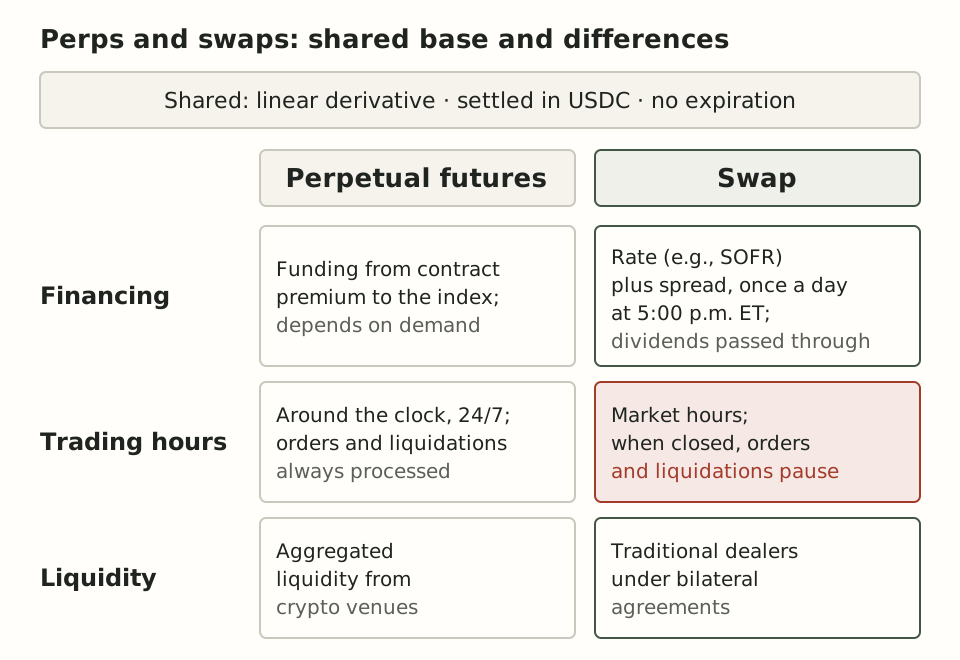
According to the documentation’s comparison table, the instruments share a linear payoff, settlement in USDC, no expiration date and the availability of leverage. The differences lie in the financing mechanics, the schedule, the margin mode and the source of liquidity.
Rate-based financing, not premium-based
Funding on a perpetual contract, according to the documentation, is calculated from the premium of the contract price to the index and changes with supply and demand. The mechanics are covered in detail in “Funding rate: where it comes from and why it changes”.
For a swap, financing accrues once a day — at the market close at 17:00 New York time, Monday through Friday — on positions held through the close. The rate reflects the cost of financing the underlying asset in the traditional market. For equity indices, it is the overnight rate of the index’s currency (SOFR for dollar indices), adjusted by a spread. For currency pairs, it is the difference between the two currencies’ overnight rates, adjusted by a spread; for precious metals, the implied cost of borrowing or lending the metal against the dollar. For other commodities, as well as the volatility and dollar indices (VXI and DXI), it is the daily carry of the futures curve; its sign depends on the shape of the curve.
SOFR (Secured Overnight Financing Rate), according to the Federal Reserve Bank of New York, is a broad measure of the cost of borrowing cash overnight collateralized by U.S. Treasury securities.
Rates for longs and shorts are published separately and are generally asymmetric. Usually longs pay and shorts receive, but depending on the market either side may pay. Because the underlying markets are closed on weekends, one payment per week is tripled: on Friday for indices and commodities, and on Wednesday for currencies and metals. The documentation attributes the latter to settlement on the second business day after the trade (T+2). According to the project, the rates are derived from the financing terms Variational receives from its partners.
Dividends
If the underlying asset pays dividends, the swap passes them through: longs receive the amount, shorts pay it. The adjustment is applied at the close of the last weekday before the ex-dividend date, and payouts may be reduced by withholding tax. For index swaps, these are usually frequent small adjustments throughout the year. The documentation notes that perps on Variational also account for dividends and cash adjustments, although this is not typical for perpetual contracts in general.
Trading hours and margin
Swaps do not yet trade around the clock. Most markets are open 23 hours a day, five days a week; some have shorter hours or breaks. All are closed on weekends, and the schedule may change on holidays of the underlying exchange. While a market is closed, market, limit and trigger orders, take-profit and stop-loss orders, and liquidations are not processed until it reopens. Margin, according to the documentation, is isolated only — until 24/7 trading becomes available.
Indices and futures rolls
A swap’s index is sourced from Variational’s traditional partners and, according to the comparison table, serves only as a reference — for a perp, by contrast, the index feeds into the funding calculation. For metals and currencies, it is the spot price. For equity indices and for commodities other than precious metals, the index is built from futures, which have expiration dates. The documentation describes two ways of moving to the next contract, neither of which makes the index jump. Equity indices are converted to a spot-equivalent value. Commodity indices are built as a gradually shifting blend of the front and next contracts, and the daily drift in the index caused by the difference between their prices is, according to the project’s description, offset through financing.
Where liquidity comes from
According to the documentation, swaps are traded bilaterally, and their liquidity comes from traditional financial institutions; for perps, the comparison table names crypto venues as the source. That said, according to the July announcement, three perp markets are already testing blended liquidity, so this distinction is not absolute. The announcement explains the logic of swaps this way: traditional dealers do not post quotes to public order books but trade with counterparties they have signed agreements with. According to the team, OLP acts as such a counterparty and hedges swap positions with dealers. For an Omni user, the counterparty is still OLP.
Open questions and limitations
The update is described in detail in the documentation, but as of October 16, 2026, several questions remain unanswered or depend on future events.
- Product status. Omni is in private beta; the roadmap does not mark a public mainnet launch.
- Spreads. The cut in perp spreads of 20% or more, like the announcement’s description of swap spreads as “order-of-magnitude tighter”, is a claim by the project. The methodology, baseline period and independent measurements have not been published.
- Dependence on partners. The index, financing terms and liquidity for swaps come from traditional financial institutions that the documentation does not name. The move to 24/7 trading, according to the announcement, depends on future agreements with venues that operate outside regular hours.
- Gap at the open. From the description of the pauses, it follows that price moves in the underlying asset while the market is closed will be reflected only after it reopens. It is reasonable to assume that liquidations after the open will execute further from previous levels than they would under continuous trading. Isolated margin confines this to a single position but does not eliminate it.
- Price used for margin. The Swaps page does not describe how the mark price, used to assess margin and liquidations, is calculated for swaps if the index serves only as a reference.
- Counterparty. In Omni, OLP remains the counterparty to all trades, so the risks of the peer-to-peer model described in “Protocol and application: how Variational and Omni relate” apply to swaps as well.
Bottom line
Swaps bring to Variational a structure familiar from the over-the-counter market: the cost of holding a position is set by interest rates, the futures curve and partners’ terms, not by the balance of demand for the contract itself. The trade-off is a trading schedule, pauses in liquidation processing and dependence on unnamed traditional partners. Little is confirmed as of October 16, 2026: a roadmap entry and a detailed description of the mechanics. The claims about spreads and depth remain the project’s claims, and 24/7 trading remains a plan. More about the project is in the “Variational” section.
Sources
Spotted an error? Tell the editors — we will check it and publish a correction.
How we handle correctionsGet new articles by email
New articles and corrections, no more than once a week. No ads for trading services, no promo codes and no offers to open an account.

.JPG)