IndustryExplainer
Tokenized asset vs derivative: what is the difference
A token may represent a claim on an asset held by a custodian, while a derivative is a contract that settles against the asset’s price. We look at what rights each instrument gives and who has to honor them.
Key points
- A tokenized asset is a blockchain record meant to represent a claim on an asset held by an issuer or custodian; the scope of that claim is set by the legal structure.
- A derivative is a contract with a counterparty whose payments depend on the asset’s price; the holder does not receive the asset itself.
- A derivative pays dividend-equivalent amounts only if the contract provides for them; they are a cash adjustment from the counterparty, not a dividend from the issuer.
- IOSCO warns in a 2025 report that investors holding a token may not understand what rights to the underlying asset they actually have.
Contents · 7 sections
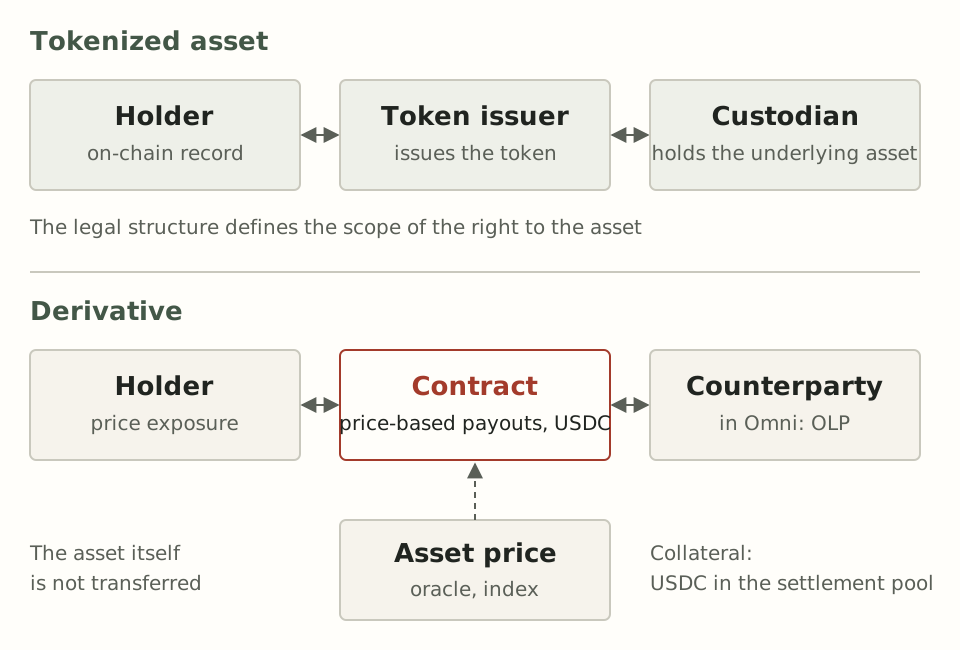
A tokenized asset and a derivative differ in what the holder actually has a claim to. A token is designed as a digital representation of the asset itself or of a right to it: somewhere, an issuer or custodian is supposed to hold the underlying asset. A derivative is a contract with a counterparty whose payments depend on the asset’s price; the holder does not receive the asset and is not meant to.
On the surface, the two can look identical: both have a ticker and a price, and both are recorded on a blockchain. But the difference in rights determines whom the holder is trusting, what they get back if an intermediary goes bankrupt and whether they have, for example, a vote. Below is how the distinction works and what risks follow from it.
What a tokenized asset is
A tokenized asset is a record on a distributed ledger that is meant to evidence a claim on a specific asset: a share, a bond, a fund unit, a gold bar. The record by itself guarantees nothing. The scope of the rights is set by the legal structure behind the token.
Those structures vary. U.S. Securities and Exchange Commission (SEC) Commissioner Hester Peirce, in a statement dated July 9, 2025, distinguishes two cases. In the first, an issuer issues its own securities in tokenized form. In the second, an unaffiliated third party that holds other issuers’ securities in custody issues tokens linked to those securities.
In the second case, she says, buyers may face particular risks, including counterparty risk. Such a token may turn out to be a separate security, distinct from the underlying one. And if the token conveys neither legal nor beneficial ownership of the underlying security, under U.S. law it may be classified as a security-based swap — that is, a derivative that retail investors cannot trade off-exchange. This is the view of one commissioner, not the position of the SEC as a whole, but it shows clearly that the word “tokenized” does not describe the holder’s rights.
What a derivative is
A derivative is a contract between parties whose payments are calculated from the price of an underlying asset. The holder gets exposure to the price — gaining or losing as it moves — but does not become the owner of the asset.
Derivatives on traditional assets exist on blockchains too. For example, Variational’s documentation describes the project as a protocol for trading derivatives, and for the Omni application (according to the documentation, a mainnet in private beta as of October 2026) it describes two kinds of such instruments. Perpetual contracts on traditional assets (TradFi perpetuals) take the underlying market’s price from the Variational oracle. Swaps, according to the documentation, are a linear derivative that aims to track the total return of the underlying asset and is quoted on both sides.
In both cases settlement is in USDC: a party receives or pays the price difference, not shares or barrels. The user’s counterparty in Omni is the project’s market maker, OLP. Variational’s Terms of Use describe these trades as derivative contracts, including perpetual futures and contracts for difference, entered into through smart contracts.
What rights each instrument gives
The main difference is the object of the claim. A token holder has a claim on the asset itself or on whoever holds it. A derivative holder has a claim on a counterparty for cash payments.
| Question | Tokenized asset | Derivative |
|---|---|---|
| What the holder has | A claim on the asset or on the custodian | A contract paying on price |
| Who it depends on | Issuer, custodian, registry | Counterparty and collateral |
| Voting | If the structure provides it | No: the holder is not a shareholder |
| Dividends | If the issuer passes them on | Only if the contract carries them |
| Settlement | Token transfer | Cash; USDC in Omni |
The table shows that many of a token’s features are conditional: voting and dividends exist only if the structure provides for them. For a derivative, some rights are excluded by definition. The holder of a contract on a share’s price is not entered in the shareholder register and does not vote, because they hold no shares.
Dividends: only if the contract carries them
A derivative does not pay dividends by itself. Dividend-equivalent payments appear only if the contract terms provide for them.
In Omni, according to the documentation, they do. For swaps on underlying assets that pay dividends, long positions receive the dividend amount and short positions pay it; payments may be reduced by withholding taxes. For perpetual contracts on stocks and exchange-traded funds (ETFs), the documentation describes a separate “dividend” funding payment in which shorts generally pay longs.
This is a cash adjustment within the contract, not a dividend in the legal sense. It comes from the counterparty, not from the company that issued the shares. In the comparison table on its swaps page, the project itself notes that for perpetual contracts such adjustments occur on Variational but are not typical in general.
Risks: counterparty, custody, legal, technology
Both instruments carry the same classes of risk, but the sources of that risk differ.
Counterparty risk. For a token, it is tied to the issuer and the custodian: if the custodian goes bankrupt or turns out not to have the asset, the token’s value depends on how holders’ rights are protected. For a derivative, counterparty risk is tied to the other party to the contract. Variational’s Terms of Use state it directly: if a counterparty’s balance in a settlement pool falls to zero or below, it cannot be forced to post additional collateral, and the user may not receive what they are owed.
Custody. For a token, the key question is who holds the underlying asset, where, and whether it is segregated from the custodian’s own property. For a derivative, the underlying asset is not held at all; what needs safekeeping is the collateral. In Omni, that is USDC in settlement pool smart contracts.
Legal risk. The International Organization of Securities Commissions (IOSCO), in its final report on tokenization dated November 11, 2025, warns that the variety of tokenized asset structures may confuse investors: holding a token, they may not understand their ownership rights in the underlying asset or their right to transfer it. Derivatives raise their own legal question — how the instrument is classified in a given jurisdiction. Variational’s Terms of Use state explicitly that commercial names such as “Perps” or “Swaps” do not determine an instrument’s legal classification.
Technology risk. Among the evolving risks of tokenization, the same IOSCO report names operational vulnerabilities and cyber threats: familiar risk categories that play out differently on distributed ledgers. For on-chain derivatives, the critical components are the smart contracts that account for collateral and the oracle whose data settlement and liquidations depend on.
Why the line can blur
In practice, one can look like the other. A token that conveys no ownership of the underlying asset and merely tracks its price is, in substance, closer to a derivative — which is why the SEC commissioner’s statement allows that such a token may be classified as a swap. Conversely, a derivative that passes through dividends looks like owning the asset, even though the holder’s rights remain cash claims against the counterparty.
So it is more useful to look past the name to the answers to a few questions. What exactly does the holder get: the asset, a claim on a custodian or cash payments? Who is obligated to honor that right? Where is the asset or the collateral, and what happens to it if an intermediary goes bankrupt? How is the instrument classified in the holder’s jurisdiction?
Bottom line: what the holder actually owns
Tokenization by itself changes the form in which rights are recorded, not their substance: that is set by the legal structure. A derivative does not claim ownership of the asset at all: it transfers the economic result of price changes through a contract with a counterparty.
For swaps and perpetual contracts on traditional assets in Omni, according to the documentation, this means price exposure, settlement in USDC and dividend-equivalent payments only where the terms provide for them — with no ownership of the asset itself. How these two kinds of contracts differ from each other is covered in “Swaps on Variational: what changed in 2026 and how they differ from perps”.
Legal questions remain open, and by regulators’ own assessment they are still being resolved in different ways: how to classify a token without ownership rights, how holders are protected if a custodian goes bankrupt and what rules apply to on-chain derivatives in each jurisdiction.
Sources
Spotted an error? Tell the editors — we will check it and publish a correction.
How we handle correctionsGet new articles by email
New articles and corrections, no more than once a week. No ads for trading services, no promo codes and no offers to open an account.



_Futtersilos-2024-RM-151016.jpg)