Basics and risksAnalysis
Zero trading fees: the costs that remain
Removing the trading fee takes away one line of costs, not all of them. We look at what else makes up the cost of a trade: spread, slippage, funding, liquidation penalties and transfer fees.

Key points
- Explicit charges appear as a separate line; implicit costs such as spread and slippage are built into the execution price.
- Funding and the liquidation penalty do not arise on every trade; they depend on how long a position is held and how well it is collateralized.
- According to Omni's documentation as of October 2026, there are no trading fees, revenue comes from the spread and 20% of spreads goes to the protocol treasury; that share is still being tested.
- The same documentation lists, as of the same date, a $0.1 deposit or withdrawal fee and a liquidation penalty of 0.5% beyond the bid or ask price.
Contents · 7 sections
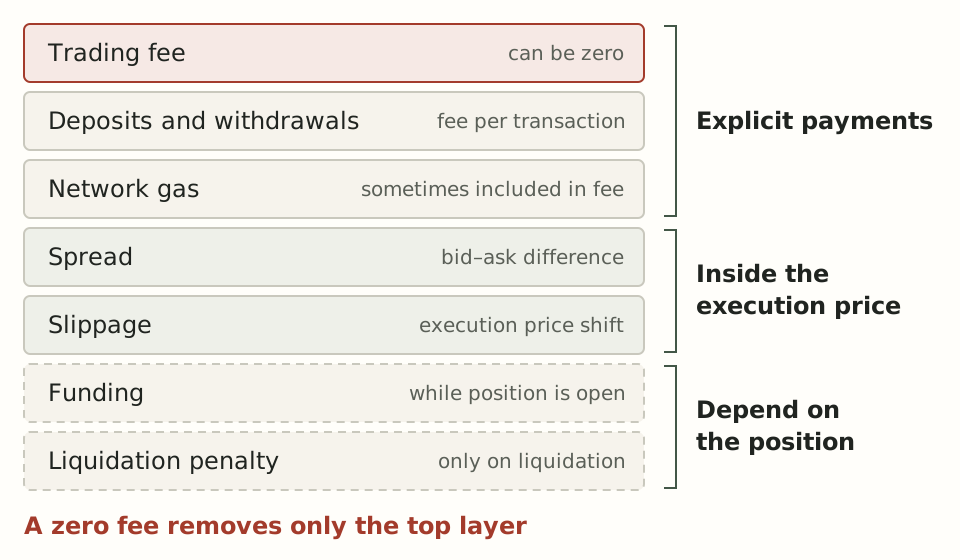
If a venue charges no trading fee, what does a trade cost? The answer is not zero. The trading fee is only one line of costs, and the most visible one. The others are either built into the execution price (spread and slippage), arise only under certain conditions (funding and the liquidation penalty), or are charged for operations outside trading itself (deposits, withdrawals and network gas).
Every venue and every market maker has expenses, and the revenue to cover them is collected either through a fee or in some other way. So the phrase “no fees” tells you how revenue is structured, not what a trade costs in full. Below we go through each line and show how these lines are described in the documentation of Omni, an application built on the Variational protocol.
Explicit and implicit costs
Explicit costs are charges that appear as a separate line: the trading fee, a deposit or withdrawal fee, gas. Implicit costs are built into the price at which a trade is executed and are not shown separately.
Implicit costs are harder to notice precisely because they do not appear in the payment history. To see them, you have to compare the execution price with some reference price: the midpoint between bid and ask, the index price or the contract's mark price. The choice of reference also determines the amount you end up with.
There is a third group: contingent costs. They depend not on the trade itself but on what happens to the position afterward: how long it stays open and whether its collateral is sufficient. For perpetual contracts, this group includes funding and the liquidation penalty.
Spread: the price of immediate execution
The spread is the difference between the price at which you can buy (ask) and the price at which you can sell (bid). Someone who buys and immediately sells loses roughly this spread, even if no fee was charged.
For a market maker, the spread is the main source of income and also compensation for the risk of holding a position. For a venue without fees, the spread also becomes a revenue channel. According to the fees page, Omni earns revenue from the spread rather than from fees. The OLP page adds that the Variational protocol receives a share of the spreads paid to the Omni Liquidity Provider (OLP) market maker: as of October 2026, 20%, which is transferred to the protocol treasury. The documentation notes that this share is still being tested and may change. The project presents the absence of fees as an advantage of a model in which a single market maker is built into the venue; this is the project's claim, not an editorial assessment.
This means that revenue which, under a fee-based model, would appear as a separate line is collected here within the price. The documentation does not allow you to conclude whether this makes the overall cost of a trade higher or lower: the size of the spread is not fixed and depends on the market and the size of the trade. For a general definition, see the glossary: spread.
Slippage and the firm quote
Slippage is the difference between the price a participant expected and the price at which the trade actually executed. It occurs when the price moves before execution or when the size of the trade itself moves the price.
On Omni, according to the documentation, quotes shown in the interface are indicative: they reflect OLP's current view of the market and are not a commitment to execute at that price. When a user submits an order, OLP generates a firm quote, the exact execution price, which may turn out better or worse than the indicative one.
An important detail is the reference point. The slippage page defines slippage as the difference between the mark price, the contract's calculated fair price, and the execution price. One can assume that under this definition, slippage also captures the deviation of the quote from the mark price, that is, part of what in other contexts is called the spread.
There is one more subtlety. The quotes and prices page mentioned above describes the mark price on Omni as a value derived from the index price and additional data, including funding and OLP's current risk profile. In other words, the reference price from which slippage is measured itself partly reflects the market maker's position. So figures for “slippage” from different sources should only be compared with an understanding of the price they are measured from.
The documentation also notes that large orders are more exposed to slippage and describes a slippage limit, a parameter beyond which a market order is rejected. The limit only sets the acceptable deviation; it does not remove the cost itself.
Funding: the cost of holding a position
Funding is a series of periodic payments between the two sides of a perpetual contract that keep its price close to the index price. For a given position, it can be either an expense or income, depending on the sign of the rate.
According to Omni's documentation, when the rate is positive, long positions pay short ones; when it is negative, the reverse. This is not a payment to the venue for the trade, but it affects the position's result and accumulates over the time the position is held. Since OLP is the counterparty to every position on Omni, one can conclude that a user's funding effectively goes to OLP or comes from it; the documentation does not state this separately. The same page notes that swaps on Omni use a different funding mechanism, tied to actual financing costs in traditional markets. The name of the payment is the same, but the logic of the calculation differs. How the rate is formed is covered in a separate article on the funding rate.
The liquidation penalty
The liquidation penalty is an additional cost that arises only if a position is forcibly closed because of insufficient collateral. In the normal life of a position, it does not apply.
According to the same fees page, as of October 2026 Omni closes a liquidated position at the ask price plus 0.5% for a short position, or the bid price minus 0.5% for a long one. So the penalty is added on top of a price that already includes the spread. The liquidation mechanism and what drives its risk are covered in the article on margin and liquidation.
Deposits, withdrawals and gas
Moving funds to a venue and back can cost money even when there is no trading fee. In blockchain applications, gas is behind this.
Ethereum.org defines gas as the unit of computational effort required to execute operations on the Ethereum network; gas fees protect the network from spam. Gas also exists on layer 2 networks, including Arbitrum, where Variational's contracts are deployed. Who pays it depends on the application: sometimes the user pays directly, sometimes the application charges a flat fee. According to the protocol overview, gas for deposits and withdrawals on Omni is paid by a service component of the protocol, the transactor. Omni in turn charges the user, according to the documentation as of October 2026, a flat $0.1 per deposit or withdrawal, in the project's words to discourage spam and cover gas costs. A flat fee does not depend on the amount transferred, so its share is more noticeable the smaller the amount.
Conclusion: “zero” applies to one line
“Zero trading fees” accurately describes the fact that a venue does not issue a separate charge for a trade. It does not describe the full cost of a trade: spread and slippage remain inside the price, funding and the liquidation penalty depend on the position, and transferring funds can cost money. In Omni's model, as the documentation describes it, the revenue of the venue and the protocol is shifted specifically into the spread.
This suggests questions worth asking about any “no fees” model: where does the venue get its revenue, from which price is slippage measured, who receives funding payments, which terms are fixed and which, like the spread share on Omni, are explicitly described as provisional. The documentation does not give the size of the spread: it is visible only in specific quotes and changes with the market. That is why the full cost of a trade cannot be judged from the single “fee” line, on Omni or on any other venue.
Sources
Spotted an error? Tell the editors — we will check it and publish a correction.
How we handle correctionsGet new articles by email
New articles and corrections, no more than once a week. No ads for trading services, no promo codes and no offers to open an account.