IndustryExplainer
Where liquidity comes from and why it is finite
Behind every quote is someone's capital and willingness to bear risk. We look at who supplies liquidity, what limits it and how those limits are described in the Variational documentation.

Key points
- Liquidity is described along three dimensions: the cost of an immediate trade (spread), depth and speed of recovery.
- It is supplied by limit order posters, AMM reserve providers and market makers who hedge their positions.
- The limits are set by capital, risk limits, inventory risk, the availability of hedging venues and volatility.
- The Variational documentation describes OLP's constraints: vault capital, a VaR limit and limits on open interest and skew.
Contents · 5 sections
Why can't you buy any amount at the price shown on the screen? Because the price on the screen is an offer from specific participants for a specific size. Behind every quote is someone's capital and someone's willingness to take on risk, and both are limited.
Liquidity does not arise from the market itself: it is supplied by people, funds and algorithms that have budgets, limits and the ability to pass risk on. When those resources run out or become expensive, liquidity shrinks. Below is what liquidity consists of, who provides it and where its limits lie.
Three dimensions of liquidity
Liquidity is the ability to trade a meaningful size quickly at a price close to the market. A report by the Markets Committee of the Bank for International Settlements (BIS) identifies three dimensions of it (BIS).
The first is tightness: how much it costs to buy and immediately sell a position of typical size. In practice it is most often seen in the spread between the bid and ask prices; the report calls this the “price of immediacy.” The second is depth: how much volume it takes to move the price by a given amount, or the “price of size.” The third is resiliency: how quickly the spread and depth recover after a sharp event.
The report also explains where the price of liquidity comes from in the first place. Two participants rarely want to make exactly opposite trades at the same moment, so the one who needs the trade now compensates the other side for waiting and for risk by agreeing to pay slightly more, or receive slightly less, than the fair price. This compensation is called execution cost; in a liquid market it is small.
According to the same report, the dimensions matter differently: for a small trade, tightness matters most; for someone who trades infrequently, tightness and depth; and for someone building a large position or actively managing a portfolio, all three. The general term is explained in the glossary entry on liquidity.
Who supplies liquidity
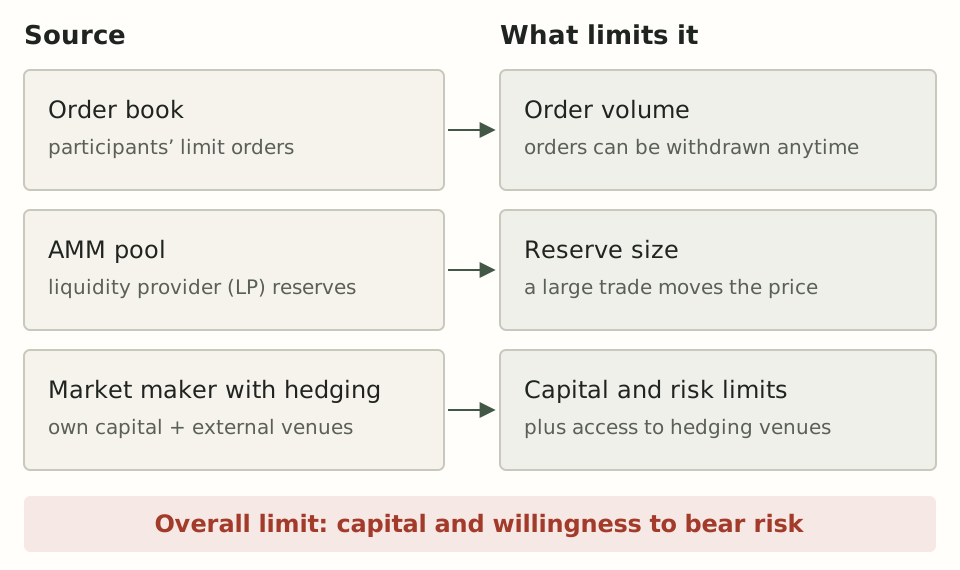
Liquidity is supplied by participants willing to commit capital in advance to a promise to trade. The mechanics depend on how a venue is built, but suppliers fall into three types.
The first type is the posters of limit orders in an order book. Each order is a promise to buy or sell a certain size at a certain price, and while it stands, its author risks the market moving against them. The second is AMM reserve providers. According to the Uniswap documentation, anyone can deposit a pair of tokens into a pool, swap fees accrue to the providers, and the larger a trade is relative to the pool's depth, the more it moves the price.
The third type is market makers, who continuously quote both sides and hedge the accumulated position on other venues. BIS describes the goal of such algorithms as earning the spread while tightly controlling inventory and trying to avoid trading with a better-informed counterparty. How these three models differ as architectures is covered in “RFQ, AMM and order books: three ways to arrive at a price”.
Why liquidity is finite
Liquidity is finite because each of its suppliers risks their own money and limits that risk. Several limits can be identified, and they act at the same time.
Capital. A market maker cannot hold positions larger than its collateral allows. An AMM pool cannot pay out more than it holds.
Risk limits. Even with spare capital, a participant limits the size of a position, its potential loss and its concentration in a single asset.
Inventory risk. A market maker that has sold an asset to a client is left with a short position until it closes it. The larger and more one-directional the flow of trades, the longer and more expensive it is to carry such inventory.
Availability of hedging venues. A market maker can quote with confidence only if it can pass the risk on. If the external market is closed or thin, there is nothing to hedge with, and quotes can be expected to become smaller in size or wider in price. It is logical to assume this affects instruments tied to traditional markets with trading hours the most.
Volatility. In sharp moves, the risk of every standing order increases, and suppliers reduce their order sizes or withdraw them. BIS cites the U.S. Treasury market on October 15, 2014: according to a joint report by U.S. agencies, order book depth fell to very low levels before the period of extreme volatility, and dealer banks widened their spreads. The example shows that liquidity can shrink precisely when demand for it grows.
An example from the documentation: OLP's limits
The Variational documentation makes it possible to see these limits in a concrete setup. In the Omni application (mainnet in private beta as of October 2026), the sole market maker and counterparty to all trades is the Omni Liquidity Provider (OLP). The example is given to illustrate that liquidity has boundaries, not as an assessment of the product.
Capital. According to the OLP documentation, OLP consists of a vault — a smart contract holding capital in USDC — a market-making engine and a risk management system. The vault serves as the source of OLP's margin. According to the documentation, the initial capital was provided by the team; opening the vault to outside deposits is described as an intention, and on the roadmap as of October 2026 this item is not marked as completed.
Hedging. OLP hedges the directional position accumulated from user trades on external venues as needed. According to the project, only OLP's own capital is used for this, and traders' funds are not transferred to external venues. This means the volume OLP can safely take on depends, among other things, on the availability and depth of those venues and on the capital that can be deployed there.
OLP's risk thus splits into two parts: positions with users inside the protocol and hedging positions on external venues. The documentation separately addresses the scenario of an external venue failing: in that case OLP depositors may bear the loss, while traders' funds, according to the project, remain in the settlement pools because they were never moved.
Risk limits. The risk limits page lists the checks that can cause a trade to be rejected. Among them are an aggregate value at risk (VaR) limit across all OLP positions, limits on gross and net notional value and a maximum size for a single OLP position. There are market-level constraints as well: open interest in an asset is capped at a share of the underlying token's fully diluted value (FDV), and skew — the difference between long and short open interest — is also capped at a share of FDV. Separate notional limits also apply to each user.
Note that the open interest and skew limits tie the permitted volume to the size of the underlying market itself: the smaller a token's FDV, the less open interest the venue is willing to accept in it. This is consistent with a more general logic: it is hard for a market maker to consistently offer more volume than it can pass on to the hedging market. The documentation does not give numerical values for the limits.
The limits show up not only in rejections but also in price. According to the prices page, OLP's quotes depend on market conditions, trade size, available liquidity and OLP's current risk profile. In other words, the visible price applies to a certain size at a certain moment, not to any trade.
It is telling how the documentation describes hitting a limit: OLP is “currently at its maximum risk capacity,” and a new trade can go through once other participants close their positions or deposits into OLP increase. This states plainly that the volume of liquidity here is set by the capital and limits of a single participant. Note that, as mentioned above, outside deposits into the OLP vault were not open as of the date of review, so growth in capital depends on the team itself.
Market hours. For swaps on traditional assets, the documentation names the source of liquidity — traditional financial institutions — and notes that swaps do not yet trade around the clock: during closed hours, trading is paused and orders and liquidations are not processed. This is an example of how the trading hours of external markets directly limit available liquidity.
Summary: liquidity is someone else's risk
Liquidity is less a property of an asset or a venue than a service provided by specific participants who take on risk in exchange for compensation: the spread, pool fees or market-making income. This service always has a limit — capital, risk limits, the ability to hedge — and under stress that limit narrows.
To understand how any venue works, it helps to ask four questions: whose capital stands behind the quotes, what limits apply to it, where and during which hours that risk is hedged and what happens when a limit is reached. The Variational documentation answers some of these questions. The size of OLP's capital and the specific limit values remain open: they are not published, so the documentation does not allow one to judge where exactly the limit lies.
Sources
Spotted an error? Tell the editors — we will check it and publish a correction.
How we handle correctionsGet new articles by email
New articles and corrections, no more than once a week. No ads for trading services, no promo codes and no offers to open an account.