VariationalExplainer
What is Variational: the protocol, its applications and how the ecosystem fits together
Variational describes itself as a protocol for trading and settling derivatives, not as an exchange. We look at its components, how Omni and Pro differ and which risks the documentation itself names.

Key points
- Variational is a protocol: a set of on-chain and off-chain components for booking, clearing and settling derivatives; users interact with it through applications.
- As of October 2026, according to the documentation, one application is running — Omni (mainnet in private beta); Pro has not launched.
- Funds are split across isolated settlement pools with an explicit counterparty; prices are set through a request for quote (RFQ), not an order book.
- The documentation names the risks directly: bad debt if a counterparty goes bankrupt, possible losses by the OLP market maker and no outside insurer.
Contents · 8 sections
Variational is not an exchange and not a single trading app. It is a protocol: infrastructure that automates entering into, clearing and settling derivatives trades. The project itself describes it as a protocol for on-chain derivatives trading across crypto, equity, commodity and currency markets.
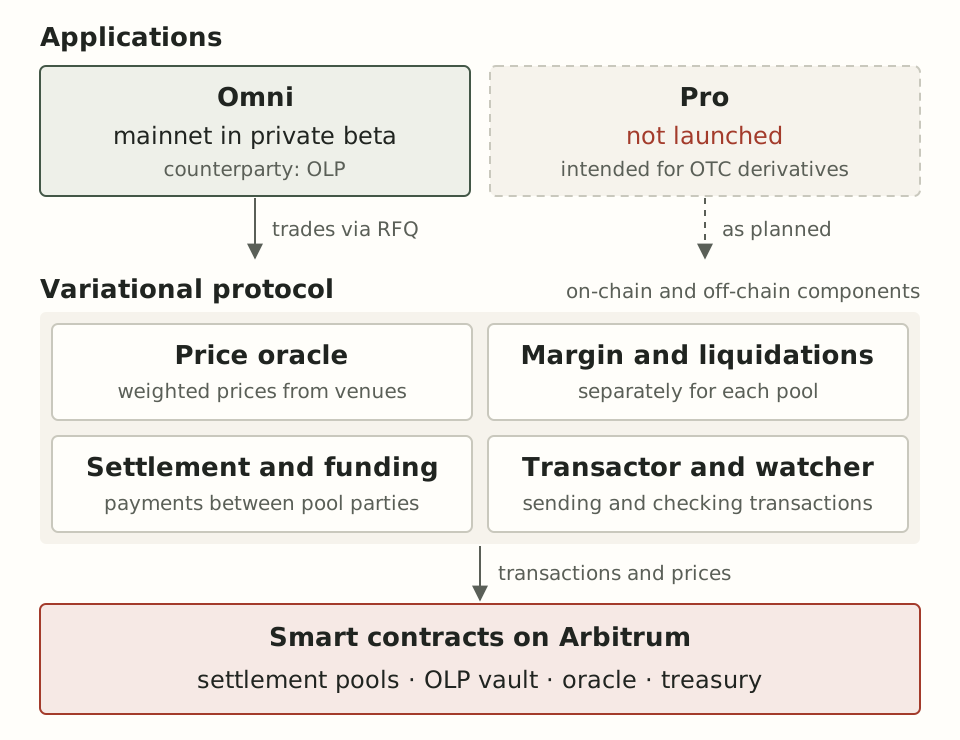
Users do not work with the protocol directly. What they see is an application built on top of it. As of October 2026, according to the documentation, two such applications are described and one is running: the Omni mainnet is in private beta, and Pro has not launched.
Below we look at the parts that make up this structure, how Variational's model differs from a familiar exchange and which limitations the documentation itself acknowledges.
Protocol and applications: two different layers
The protocol handles the shared mechanisms — position records, collateral, margin, liquidations and settlement; the application decides who trades with whom and on what terms. According to the protocol overview, Variational is “a collection of on and off-chain infrastructure” for booking, clearing and settling derivatives trades.
This distinction matters when reading any claim about the project. The phrase “Variational lets you” may refer to the capabilities of the protocol as a whole, or to the specific configuration of one application. The introductory chapter of the documentation says the protocol “currently” powers two applications, yet on the Pro page the same documentation states that Pro has not launched. The first statement is better read as a description of the architecture, not of working products.
Omni: a working application in private beta
Omni is the first application on the protocol. As the project describes it, Omni is a single cross-margin account for perpetual contracts (perpetuals) on crypto and traditional assets. The roadmap also marks the launch of swaps — a separate instrument type with its own rules. According to the project, there are several hundred markets; the exact number differs across the project's own sources, so we do not cite it.
Omni's key feature is a single market maker. Users enter into all trades with the Omni Liquidity Provider (OLP), which acts as the counterparty to each one. The roadmap marks the launch of the Omni private mainnet in the first quarter of 2025, while the public mainnet launch was not marked as completed as of the fact-check date.
Pro: described but not launched
Pro is intended for institutional participants in the over-the-counter (OTC) derivatives market. As designed, it would let participants customize contract structure, set margin and liquidation rules for each pool and receive quotes from several market makers at once.
But the Pro page says plainly: “Variational Pro is currently not live.” The roadmap item for the Pro launch is not checked off. Everything said about Pro reflects the project's intentions, not a description of a working system.
What the protocol is made of
The protocol consists of four core components shared by all applications: a pricing oracle, a margin and liquidation engine, a settlement and funding engine and an on-chain transaction handler (the transactor and the watcher). The table summarizes their functions according to the documentation.
| Component | What it does, per the documentation | What to know |
|---|---|---|
| Pricing oracle | Collects prices from various venues and computes a weighted estimate | Proprietary, not third-party; weights not publicly disclosed |
| Margin and liquidation engine | Calculates collateral requirements, liquidates positions | Runs separately for each pool |
| Settlement and funding engine | Calculates the settlement price, funding rates and payments between parties | Omni does not use settlement at expiry |
| Transactor and watcher | Submits transactions to the network and checks their finality | On Omni, the transactor pays gas for deposits and withdrawals |
The main requirement for supporting a new asset, according to the project, concerns the oracle: there must be reliable price sources and an algorithm that derives a “fair value” from them. According to the same page, the watcher protects against fake deposits and makes sure balances in the application reflect the state of the network.
The documentation does not specify, line by line, which parts of each component run on the blockchain and which run on servers. The description suggests that price and margin calculations and transaction submission are off-chain services, while the collateral contracts and the oracle contract live on-chain. This is our interpretation; for more on this split, see the article on combining on-chain and off-chain components.
Settlement pools instead of a common pot
In Variational's model, user funds are not pooled in a single vault. They are distributed across isolated settlement pools — smart contracts, each with its own participants. On its page comparing the protocol with an exchange, the project calls itself a peer-to-peer protocol and contrasts the two models.
| Peer-to-peer model | Exchange model | |
|---|---|---|
| Funds | Split across pools | Commingled in a shared vault |
| Price discovery | Request for quote (RFQ) | Central order book |
| Counterparty | Explicit | Anonymous |
On Omni, each user has their own settlement pool with OLP. According to the documentation, the bankruptcy of one pool does not affect the others: the loss is not spread across all users, as can happen on an exchange with a shared vault.
Isolation has a flip side. On an exchange, as the documentation explains, payment to the winning side is guaranteed by the solvency of the venue itself, even if a particular counterparty has gone negative. The peer-to-peer model has no such backstop: the only thing securing trades is the money deposited in the pool.
RFQ instead of an order book
In Variational, a price is set not by matching many orders but by a market maker's response to a request. According to the documentation, the protocol works through a request for quote (RFQ) and does not use an order book.
In general terms, the process works like this. The party that wants to trade (the taker) creates a request. Market makers respond with quotes that specify a price and the pool terms: margin requirements, the liquidation penalty and other parameters. The taker picks a quote, and the maker keeps the right of final confirmation (last look). Only after that is collateral moved into the pool and the trade booked.
On Omni this process is simplified: there is one maker — OLP — and a quote consists of the price alone, because the other parameters are set in advance. How RFQ differs from an order book and from an automated market maker is covered in “RFQ, AMM and order books: three ways to arrive at a price.”
Where the protocol is deployed: Arbitrum
Variational's mainnet contracts are deployed on Arbitrum, a layer 2 (L2) network on top of Ethereum. The contracts page lists four addresses with links to the Arbiscan explorer: the protocol treasury, the main OLP vault, the settlement pool factory and the oracle contract.
This means the security of records of funds depends not only on Variational's code but also on the properties of the Arbitrum network itself: how it orders transactions and when they become final on Ethereum. These properties are covered in “Why crypto applications use layer 2: the Arbitrum example.”
Why it was built: the team's position
According to the team, Variational is built around its own market maker integrated into the venue, so as not to depend on outside market makers. This is the project's position, not an established fact. According to the page on why Variational was built, co-founders Lucas Schuermann and Edward Yu left leadership roles at a large OTC desk in 2021 and founded their own trading firm.
The team writes that two years of working with large centralized and decentralized venues led it to three conclusions: launching new markets on order books requires subsidizing outside market makers; the exchange model continually gives up part of the value to them; and institutional trading in complex derivatives remains largely manual. These are arguments for the project's own model; the sources contain no independent assessment of these claims.
This choice has a direct consequence. Vertical integration means the venue's market maker is at once the user's counterparty and the venue's source of revenue: according to the documentation, Omni earns from the spread, not from fees. How this works is covered in “Protocol and application: how Variational and Omni relate.”
Limitations and risks the documentation itself names
Variational's documentation itself names three groups of risks: bad debt if a counterparty goes bankrupt, possible losses by the OLP market maker and the unfinished state of a product that is in private beta.
One more observation follows from how the system is built. Because OLP is the counterparty to all trades on Omni, pool isolation protects users from one another but not from problems at their common counterparty. A second observation: the pricing oracle is proprietary and its weighting methodology is not publicly disclosed, so the correctness of the prices used for margin and liquidations can be verified from outside only in part.
Bottom line: infrastructure plus one application
Variational is most accurately described as an infrastructure layer for bilateral trades with an explicit counterparty, on top of which, as of October 2026, one application runs — Omni, with its built-in market maker. Many of the features that stand out in Omni, such as the single counterparty and uniform margin rules, are choices made by the application, not limits of the protocol.
The documentation does not yet answer the questions on which an assessment of the whole structure depends: how parameters and the set of participants will change after the public mainnet launch, how resilient OLP is during sharp market moves and how risks will be distributed if Pro, with several market makers, does launch.
Sources
Spotted an error? Tell the editors — we will check it and publish a correction.
How we handle correctionsGet new articles by email
New articles and corrections, no more than once a week. No ads for trading services, no promo codes and no offers to open an account.